
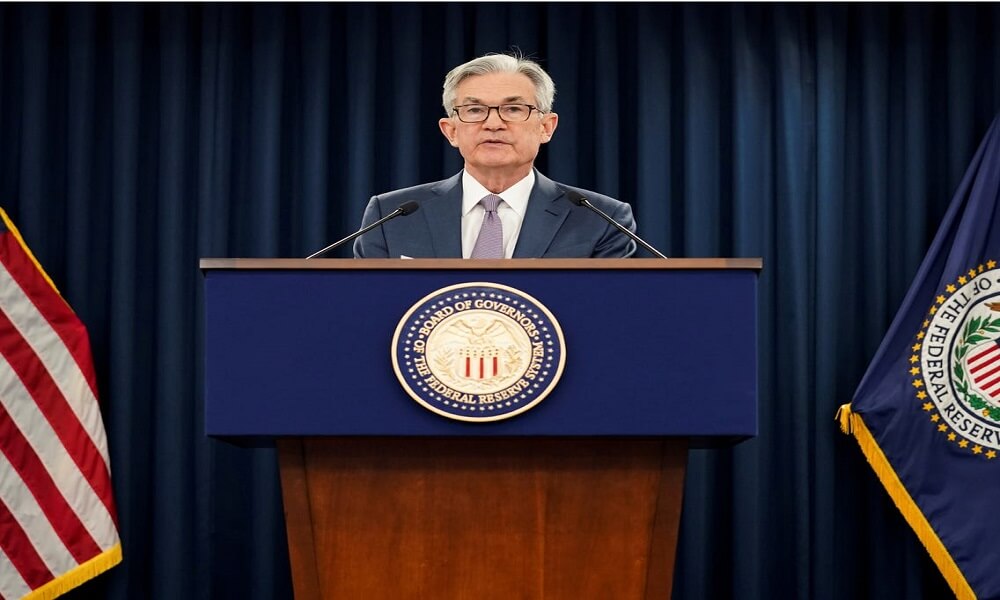
Fed Chair Powell Says He Has ‘No Intention’ Of Banning Crypto


U.S. Federal Reserve Chairman Jerome Powell said he does not intend to ban cryptocurrencies, but said stablecoins need greater regulatory oversight.

Powell made the comments in a two-hour long House Financial Services Committee meeting on Thursday. The meeting, meant to serve as a forum for representatives to ask Treasury Secretary Janet Yellen and Powell about the Treasury Department’s and Federal Reserve’s pandemic response, featured several questions about cryptocurrencies.

Rep. Ted Budd (R-N.C.), a longtime proponent of crypto and a member of the Congressional Blockchain Caucus, asked Powell to clarify statements he had made during a July hearing that the development of a U.S. central bank digital currency (CBDC) could undercut the need for private crypto and stablecoins.

When asked by Budd directly whether or not he intended to “ban or limit the use of cryptocurrencies,” Powell’s response was a resounding “No.”

“[I have] no intention to ban them,” he said.
 

Powell’s remarks come just two days after he asked Congress for consultation and legislative support to develop the digital dollar. Some in the crypto community have speculated that the establishment of a U.S. CBDC would lead to bans on private crypto, as was recently seen in China, but Powell’s remarks suggest otherwise.

When asked about stablecoins, Powell compared them to money market funds or bank deposits.

“They’re to some extent outside the regulatory perimeter, and it’s appropriate that they be regulated. Same activity, same regulation,” Powell said.
 

Rep. Warren Davidson (R-Ohio), also a member of the Congressional Blockchain Caucus, remarked on the lack of regulatory clarity surrounding digital assets, and asked Yellen to define digital assets for tax-accounting purposes. Continue reading with coindesk

 

Comments

Popular posts from this blog

India's Foreign Exchange Reserves Will Decrease Further

As the Reserve Bank of India continues to defend the rupee against the stronger dollar, a Reuters poll predicts that by the end of 2022, India's shrinking foreign exchange reserves will have fallen to their lowest point in more than two years. In an effort to halt the rupee's slide to a historic low against the dollar, the RBI has decreased its foreign exchange reserves by roughly $100 billion, to $545 billion from a peak of $642 billion a year ago, and more is on the way. By the end of this year, those reserves are anticipated to fall by another $23 billion to $523 billion, according to the median forecast from a Reuters poll of 16 economists conducted on September 26-27. If achieved, that would be the lowest level in more than two years. From $500 to 540 billion was predicted. This suggests that the RBI would keep depleting its foreign exchange reserves at a rate unseen since the global financial crisis of 2008, when they decreased by around 20%. The US Federal Reserve has al...

Ethereum reports that the Merge Upgrade was successful.

Ethereum is a decentralized blockchain technology that enables the execution and verification of smart contracts. Participants can engage in transactions without the requirement for a central authority when using smart contracts. Participants have full ownership and visibility of immutable, verifiable, and securely distributed transaction records. Ethereum accounts send and receive transactions. Senders must sign transactions and pay in Ether for the network to process them. According to Ethereum, the Merge upgrade was successful, and there will be more. The Merge is a significant step toward reducing the amount of power required by the Ethereum blockchain, but other improvements are still in the works. The Ethereum Foundation reports that the final phase of the Paris upgrade was completed at 2:45 p.m. Hong Kong time, bringing an end to the lengthy wait for the Ethereum network upgrade. The Merge will cause the architecture of the second-largest blockchain in the world, with a market v...

$2B In Crypto Stolen From Cross-Chain Bridges This Year: Chainalysis

  Cross-chain bridge hacks have accounted for 69% of the total  crypto stolen   in 2022, amounting to $2 billion in losses, according to a new report.  The report comes from blockchain analytics firm Chainalysis on Aug. 2, noting there have been 13 separate token bridge hacks this year — the most recent being the $190 million Nomad Bridge exploit. Q1 2022 was by far the quarter that saw the most amount of crypto stolen since 2021, due mainly to the Ronin Bridge Attack in late March, which saw $624 million in  Ether  (ETH) and  Circle USD  (USDC) stolen.   Trade With Trustworthy Broker ✅ AssetsFX ✅ Cross-chain bridges, also known as blockchain bridges are designed to transfer cryptocurrencies from one blockchain network to another.  Chainalysis explains that while bridge designs vary, users typically deposit their tokens from one chain to the bridge protocol which are then locked into a contract. The user is then issued the equivalent of...